Introduction
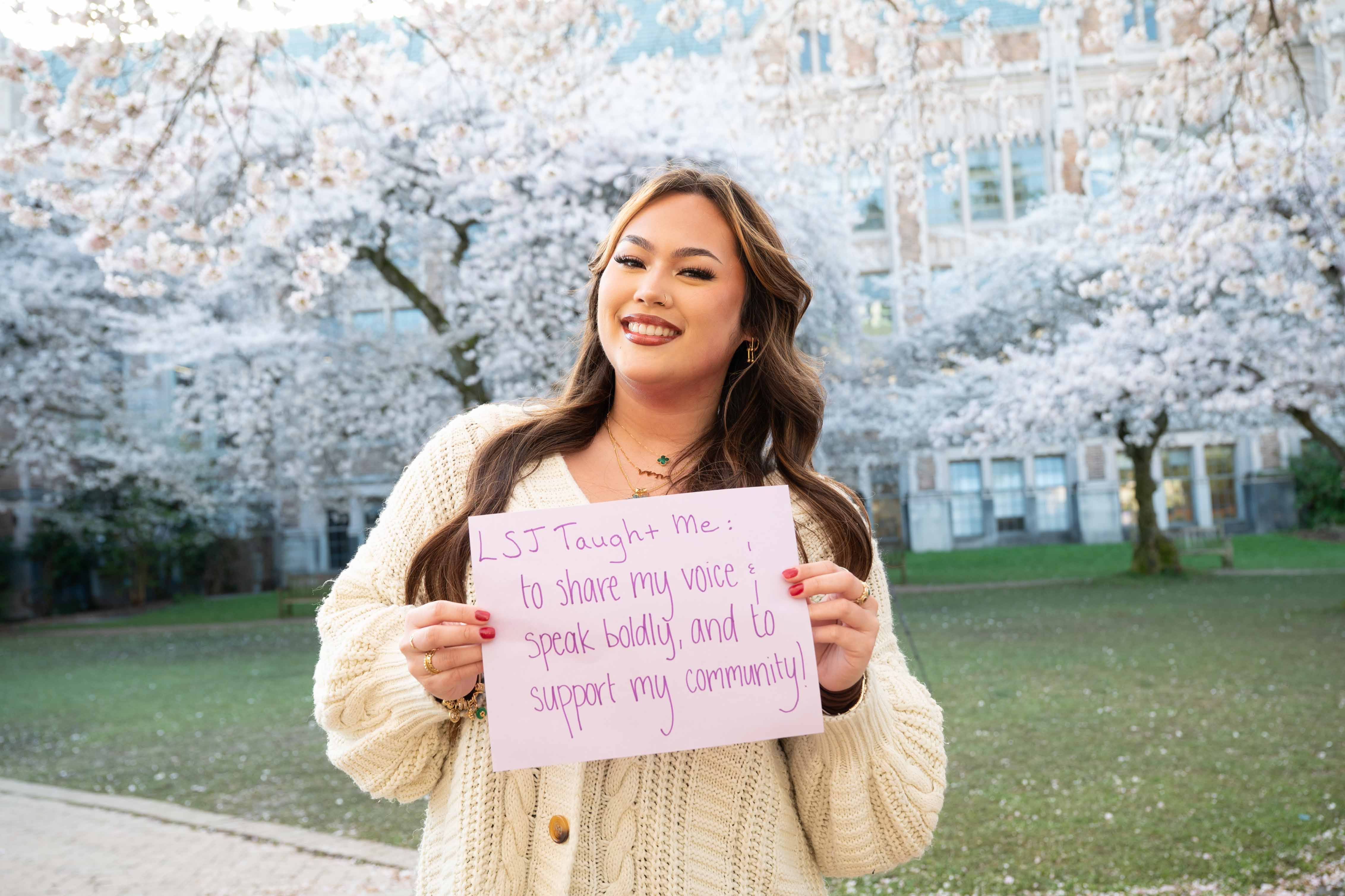
This year marks the 25th anniversary of the Law, Societies & Justice (LSJ) Department at the University of Washington. Now a well-respected department, LSJ boasts 280 majors and could accommodate more if its modest faculty size did not impose a tight cap on admissions. “LSJ creates an opportunity to study the nature of law, the experience, and history of law, and the way law impacts us,” says Jamie Mayerfeld, current department chair. “It is also an opportunity to think about the relation of law to justice, the way in which law can be a resource for promoting justice and also an impediment to justice.” The program’s 25th anniversary is a fitting opportunity to recall the story of how LSJ came into being and developed into one of the most popular majors in the College of Arts and Sciences.
Origins of LSJ
LSJ originated in the vision of Michael McCann, a professor and (from 1995 to 2000) chair of Political Science. The predecessor of LSJ was a small program called “Society and Justice” which focused on criminal justice. McCann taught courses on constitutional law and civil rights law for the program and frequently served as its director between 1988 and 1999. Over the years, faculty commitment frayed, but student interest remained high. In 1999, McCann led a team of colleagues in submitting a successful application to the University Initiative Fund to create a more ambitious and internationally focused program called “Law, Societies & Justice.” Deans in the College of Arts & Sciences contributed more resources, and McCann was appointed founding director of the new program in 2001.
McCann and his colleagues constructed a new curriculum balancing civil rights and human rights on the one hand with criminal justice issues on the other. Six faculty hires in the first couple of years put a stamp on the new program: Professors Katherine Beckett, Rachel Cichowski, Angelina Godoy, Steve Herbert, George Lovell, and Arzoo Osanloo. “We tried to constitute ourselves as a faculty which was not just for teaching but was for an intellectual community so that we would learn from each other,” observes McCann. “LSJ was a very self-consciously interdisciplinary program.” In its first decade under McCann’s leadership, LSJ gained international renown for its scholarly rigor, rich curriculum, robust internship program, and illuminating comparative approach to the study of law, rights, and justice. Under auspices of the Comparative Law and Society Studies (CLASS) Center, LSJ was tied to a flourishing graduate program of sociolegal scholars who now hold prestigious academic appointments around the world.
Growth of the Program
LSJ and Geography professor Steve Herbert directed the program from 2010 to 2019. Like McCann, a recipient of the prestigious UW Distinguished Teaching Award, he awakened growing interest in LSJ through his popular lectures, curricular reforms, and innovative programming. In 2012-13, Herbert gave students in LSJ’s group honors course a collective research problem to solve: focus on the experience of juveniles who are housed in an adult jail. Those students visited four different custodial institutions and spoke to incarcerated youths. “I saw first-hand how powerful that was,” says Herbert. “It really transformed the way the students were thinking.” Those experiences taught Herbert how impactful it was for students to be immersed in the context that they were studying.
Working with department colleagues, Herbert set about developing new immersive study programs in LSJ. The first of these, introduced in 2014, was a mixed-enrollment 400-level seminar that brought LSJ students together with incarcerated students. LSJ rented two seven-passenger vans and drove UW students down to a prison to attend their classes. Over the next few years, Herbert and Professors Katherine Beckett, Ann Frost and Megan Francis all taught mixed-enrollment classes. Herbert also initiated several prison-based book clubs which continue under the leadership of Professor Frost. Finally, Herbert oversaw the founding of the Juvenile Parole Project, which pairs undergraduate students with pro bono attorneys to represent incarcerated people eligible for juvenile parole.
During Herbert’s leadership, LSJ made the transition from a program to a department, moved to its new home in the 2nd floor mezzanine of Smith Hall, and hired Professors Rawan Arar, Ann Frost, and Stephen Meyers. Meyers added the Philanthropy Lab to LSJ’s growing menu of experiential learning programs. In this course, students solicit proposals from international NGOs and award grants to those projects they deem most likely to make a sustainable impact in advancing social justice.
LSJ and Sociology professor Katherine Beckett became department chair in 2019. After interruptions caused by the covid pandemic, she worked hard with her colleagues to restart LSJ’s experiential learning programs. “I put a lot of my attention into sustaining and adapting those kinds of experiential learning opportunities.” Frost revived the mixed-enrollment book clubs, and Beckett drew on her longstanding ties to the Seattle Clemency Project to relaunch the Juvenile Parole Project. This was also the time when Professor Angelina Godoy introduced her three-quarter class on Storytelling for Migrant Justice, in which students co-create stories with detained migrants and learn how stories can contribute to healing and justice. Under Beckett’s leadership, LSJ also hired Professors Sebastián Rubiano-Galvis and Morgan Vickers, expanding educational offerings on environmental justice and racial justice.
Alongside courses and experiential learning programs, LSJ also offers a rich menu of study abroad courses. Professors Beckett, Frost, Herbert, Lovell, Mayerfeld, McCann, Meyers, Rachel Cichowski, and Megan McCloskey have taken students to Jamaica, Amsterdam, England, South Africa, Rome, New Zealand, and Geneva to study issues such as human rights, disability rights, social control, and restorative justice.
Impact
LSJ gives students a strong liberal arts foundation and the tools to become critical thinkers. After graduation, LSJ students have pursued careers in law, justice advocacy, social work, community organizing, public service, and academia, among other fields. They apply the lessons of their LSJ education in their personal, professional, and civic lives.
Former chair Katherine Beckett observes: “I think we have filled an important niche by providing opportunities for students who are interested in questions of justice, not only to learn about it in an academic way, but also to engage in experiential learning opportunities.” She adds, “We have so much student demand for what we do, but have to turn away so many students, and it’s kind of heartbreaking. I’d love it if we could grow in terms of both our faculty and our student population.”
LSJ students and alums have emphasized the value of experiential learning. LSJ student Natalia Parker spoke of her mixed-enrollment book club, “It makes you more sympathetic and empathetic in ways that are immeasurable.” LSJ student Nicole MacMillan spoke of the Juvenile Parole Project, “When you’re an undergrad and you are conceptually learning about all of these things going on in the prison system, it can feel hard. And so, when you talk to people who are having these experiences, it grounds you and reminds you why the work you are doing is important.” LSJ alum Kaitlyn Laibe, now in her first year at Yale Law School, says of the Juvenile Parole Project, “The experience helped me realize that effective advocacy in that context meant helping someone translate their life story into a narrative the legal system could meaningfully hear. Playing even a small role in helping someone get a second look was incredibly powerful, particularly as a second-year university student.”
Laibe comments on her LSJ experience as a whole, “The LSJ Department profoundly shaped my academic path and the way I think about law and justice. Its emphasis on both critical inquiry and experiential learning helped me understand the real-world impact of legal institutions and ultimately inspired my decision to pursue law school. I am deeply grateful to the LSJ professors and academic support staff who make transformative experiences like this possible.”
Looking Back and Thinking Ahead
Current chair Jamie Mayerfeld attributes LSJ’s success to its motivated and talented students, as well as its, “uniquely brilliant and generous faculty and staff.” He singles out the contributions of LSJ’s three previous chairs and directors. “Michael, Steve, and Katherine are amazing scholars, educators, and citizens. They poured their heart and soul into creating this department. LSJ exists and flourishes because of their work.”
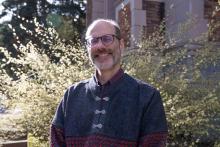
Mayerfeld adds, “One thing I love about LSJ is its broad approach to justice issues. We offer courses on human rights, disability rights, migrant rights, refugee rights, women’s rights, criminal law policy, constitutional law, comparative law, racial justice, and environmental justice. We help students understand how these things are connected to each other. LSJ is blessed with creative, dedicated faculty who will continue developing great initiatives in the years to come.”
If you are interested in supporting the work of LSJ, we invite you to make a gift to Friends of LSJ or one of our endowed funds.